Rose Butte Ranch Cowl
Brenda K.B. AndersonLearn mosaic crochet and make a beautiful cowl — FREE pattern included!
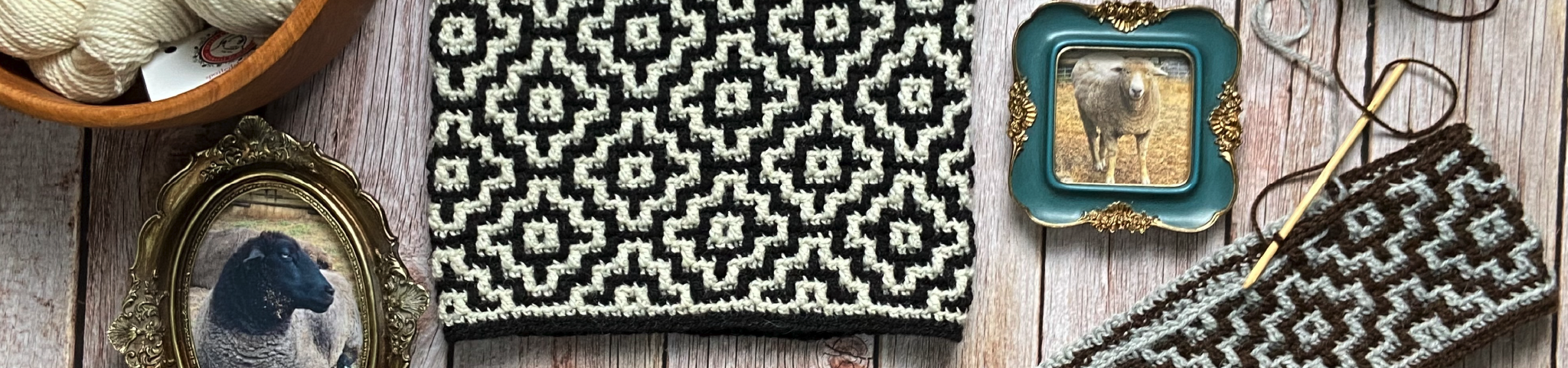
Join Brenda K.B. Anderson for a free live tutorial on the Rose Butte Ranch Cowl. Mosaic crochet has quickly become one of the most popular ways to work with multiple colors for good reason; once you learn how it works, you’ll see just how easy it really is. Can you make single crochets, double crochets, and work into the back loop? Then you can do this! Brenda will walk you through the process step by step while creating this beautiful cowl. It’s much easier than it looks and you’ll be amazed.
Hi, everybody! Welcome to our live event. My name is Brenda K.B. Anderson, and today, I'm gonna be showing you guys how to work up this mosaic cowl. So this is a mosaic crochet technique that we're gonna be working on, and it's a lot easier than you might think.
I know it looks a little complicated with all these colors going on, but I'm gonna be walking you through it. I'm gonna explain how to work from a chart. but also in the pattern download, there is also written-out directions, so if that helps you although, eh, learning from the chart is, like, really, really helpful for other people's patterns, you don't have to look- you don't have to- you don't have to work from the chart in this particular instance, but it'll kinda help you start to learn how to read f- from the chart. So anyway, I'm very excited to show you guys this project. I, I really, really love working with color.
This is something that I've explored for, you know, probably the last 10 years, I've been really into working with color, so I've done a lot of tapestry crochet. but also, more lately, I've been kinda leaning into the whole mosaic crochet thing. The reason mosaic crochet I feel like it's just had this explosion of popularity over the last few years, and I feel like the reason this is happening is because you only have to work with one color at a time, and it makes such a nice fabric. And it really is Once you understand how to do it, it's super easy to, to do. Like, you don't have to manipulate or switch back and forth between colors.
You don't have your yarn in a big, tangly mess. so it, it makes things a lot easier, especially if you're just, you know, wanting to dip your toes into the water of using two different colors, in a project, so. if you guys have any questions about what I'm doing today, definitely put that in the chat, or if you just wanna say hi, or let me know, like, what you're working on now in, in your crochet land, or if you have suggestions on future events, then put that in the chat, too, 'cause I love to hear from you guys. and I like to know what you guys are interested in doing. And this, this particular, project, this was inspired by somebody else asking if I could design a small mosaic project and, and, you know, teach the technique of mosaic crochet.
So we're going to be working this up today. This is called the Rosebud Ranch Cobble- Cowl, and there is a free download that goes along with this. This has the complete instructions. It's got the written-out instructions, but it also has a chart, like, the complete chart. and so yeah, so you can go ahead and download that and follow along, or if you wanna downlo- load that later, it'll still be there later, no problem.
you can always pick that up later when you're, thinking about starting on this project. All right, so let's st- just start by talking a little bit about, the materials we're gonna be needing. So obviously, we need two colors of yarn, and I am using This, this cowl is extra special to me because the yarn was gifted to me by my friend, Cr- Katrina Walker, and she, she actually works for the National Sewing Circle, and she does videos for them. But she happens to have, a- She lives on a ranch, and she happens to have a whole bunch of adorable sheep, and so this yarn c- came from her very sheep. We've got, like, a lighter color and a darker color, put together, but this would look really great in, like, more muted tones, like a brown and a light tan kinda color.
she just has natural-colored yarn because it comes straight from her sheep. Nothing is dyed at all. There's no dye in this. I did put a little link in the pattern download in case you wanna watch we did, like, a little live event where we talked about her sheep and living on the ranch and, and the yarn itself. If you're interested in learning about wool yarn, then you can go ahead and follow that link and watch that.
that was actually done for the Knitting Circle, and there's a little knitting project, involved in that live event as well, in case any of you guys are knitters. But also, I did put- I did list another yarn in this pattern for those of you who just are more interested in, you know, getting a, a yarn that's a commercially available yarn, and so that's what this sample is here. this is an alp- mostly alpaca. It's an alpaca-wool blend. Let's see.
I'm gonna see if there's anything else in there. There might be a little nylon in there. Okay, so alpaca and wool. That's it, yeah, in this, in this sample here. But you- if you wanna substitute with a different type of fiber, if you don't like to use animal fibers, and you wanna substitute with something else, you could use Acrylic would be a, would m- have your cowl look very similar, would be warm and soft.
if you wanted to use, like, a plant fiber, just maybe do up a little sample, like I'm gonna be showing you how to do, a little gauge swatch, and then see if you like the feel of the fabric because it's gonna have a slightly different look to it. This is very cushy, and it's warm and squishy. and if you're using a plant fiber, usually, plant fibers are not quite as squishy and soft as animal fibers, so, or, or acrylics. so it might have a little bit of a different look to it. Okay, so you're gonna be needing your yarn, and I am using This is a- I think it's listed as a light worsted, but really, it's a DK weight, in my opinion.
This particular yarn, the commercially available yarn, is, a DK weight- ... which is the number three, so that is ever so slightly thinner than the worsted-weight yarn, which, a lot of crocheters in the United States like to use worsted-weight yarn. that's the most prevalent yarn, like, for making afghans. you know, you can find it everywhere in big-box stores. this is slightly thinner than that, so, And, and if you are wondering if you can use worsted-weight yarn, if you do use worsted-weight yarn, your cowl will just be a little bit bigger, so that's just something to think about.
But you'll know right away because we're gonna start working in the round, and you'll see how large your cowl is gonna be. All right, and then besides the yarn, and, and the, the specific- the specifics of both yarns, are listed in your pattern, so you can find that in your, in your download in case you're wondering what these two different yarns are. I am using an F hook, which is a 3.75-millimeter hook, but you can use whatever hook size you need to in order to get the same gauge as I have or in order to get, you know, at least a similar close gauge, 'cause- you know, we're making a cowl here, so it doesn't matter too much if it's just a little bigger or a little smaller. You wanna make sure it's not gonna be too much smaller, though, because it might not fit over your head if it was, like, a, a couple of inches smaller. That might be a problem.
so that's just something to think about. I'm just checking out my little comments. Oh, Cindy's here! Cwolfpack3, "So happy to catch you live." Hi, Cindy, I'm glad you're here. It's been a while since we've been on at the same time.
yeah, and we've got Oh, and Sandy loves mosaic crochet. Awesome. Okay, and she, she says, "Yeah, that's exactly what I love about mosaic crochet as well." I'm guessing you're talking about how easy it is to just use one color at a time, and no tangling of yarns, and all that kind of stuff. And C- and Cindy says, "We've, we've all been in our mosaic area, er, mosaic era lately, for sure, but now you'll have to design matching accessories." Oh, that would This is, this, yeah, that would be actually really cute to have a pair of mittens or something that goes along with this. All right, and, Christine's saying they love the texture and combining different stitches.
Yeah. And Belle says, "Good morning." Good morning, Belle. I'm glad you're here. They say, "Hi from M- Massachusetts," and excited They're excited to learn more about this. "Newbie for me on this style here." Awesome.
All right, well, welcome! Thanks, you guys, for saying hi. I appreciate that. It always is nice when you guys are active in the chat because then I feel more like we're just kind of hanging out and crocheting together, which is what I always wanna be doing. Okay, so we're gonna start out.
I'm gonna be switching to these two colors, just so that you can see a little bit better what I'm doing. I just wanted to avoid using a really dark color, just so you can see my stitches a little bit better. But, you know, when you choose your colors, make sure you're choosing colors that have enough contrast between them, and if you're wondering, you know, like, how can you tell? Some- 'cause sometimes you might think, oh, well, this, you know This might be a weird example, but if you use, like, a red and a green, and you think, well, they're very different hues. But sometimes when you put hues that are, like, the same, the same lightness or darkness right next to each other, then it, like, muddies things, and you can't really see the pattern as well.
It's, like, confusing to your eyes. So I like to do this little trick of taking two yarns and just kind of twisting them together like this, and then if you can obviously tell where those little, you know, where the line's between the two colors, if you can tell there's two distinct colors here once you twist it all up, then you should be good. It should be no problem. All right, so I'm gonna start out with the darker color, and I wanna show you, I'm going to be working from the, the chart, and for mosaic crochet, I You know, people make their charts in different ways, so I'm gonna be explaining what this chart means. and of course, if you're brand-new to mosaic crochet, you'll, you'll need to know how it works.
but just note, if you are brand-new, people do make mosaic crochet, crochet charts slightly differently, from each other, so not everybody puts, puts X's in their chart. Not everybody makes them with the letters along the side, like this. so just be aware of that when you're using somebody else's chart. It may not look exactly like how I chart things. but I find it to be so much simpler to just work from the chart as opposed to reading through the directions, but I- that's because that's this- you know, like, I really enjoy having charts in general in, in crochet.
For other people, it might just help to read through the directions, and I'm telling you where to switch co- you know, from one color to the next color. I'm also telling you, you know, where you're gonna be making double crochets versus single crochets because in mosaic crochet, you're basically just switching between those two stitches. So, so if that helps you, you know, just know that that's there. All the written directions are there, so but I'm gonna be working just exclusively from the chart during this live event just so that you guys can kind of get used to it. I feel like it really helps to be able to work from the chart.
Even if you're not necessarily a chart person, you may just wanna make yourself learn from the chart because sometimes people put out patterns, and they only have charts, and they don't have any of the written instructions. And so then you, you know, y- it's gonna be hard for you to work it up if you don't have, you know, a little bit of knowledge about charts. Okay, so to start out this cowl Here, let me pull this thing here. We've got, So if we just take a look at this cowl, it's a tube shape, and you can see on the inside there's stripes between black and white. As we're working in this mosaic crochet pattern, we are doing- we're alternating between the black yarn, and then the next row is gonna be the white yarn, and then the next row is the black yarn, and then the white yarn, the white yarn.
So we're switching back and forth between the two colors, one on e- you know, on every row, you change to the other color. Also note that, you know, there's a bunch of repeats of the pattern. You can see, like, these diamond shapes repeating all the way around. there are six repeats of the chart throughout the pattern, so what that means is when you look at this chart, and you start over here, you're going to be working across the chart, and then you're gonna repeat that. So you'll do it one, two, three, four, five, and six, and then you'll move on to the next round, okay?
So this is not representing every single stitch in the whole cowl. It's just representing the pattern, like, the pattern repeats. All right, so we're gonna start out, and when we're making this cowl, and just today for the demonstration, I'm just gonna be working up a gauge swatch. But the gauge swatch is just w- like, two repeats of the, the stitch pattern instead of the six that you'll need for the cowl, so we're just making, like, a mini cowl, basically. We're gonna be doing all the same stuff as you would when you're making the cowl.
We're just making, like, a tiny version of it. Okay.... So I like to start off by working one row in single crochet and then joining instead of, you know, a- because we're gonna be working this in the round, some people will, you know, are used to just doing a long chain, joining your chain, and then working in the round. I like to do a chain, and then do one row, and then connect it, and I'll show you why as I'm working it up. But in order to make the, the gauge swatch, you're going to be chaining 33.
So I'm just gonna place my slipknot on my hook here. We're gonna chain 33 in the darker color. So one, two, three And chain pretty loosely. Four, five, six, seven, eight, nine, ten, 11, 12, 13, 14, 15, 16, 17, 18, 19, 20, 21, 22, 23, 24, 25, 26, 27, 28, 29, 30, 31, 32, 33. Okay, so what we're really doing is we're doing two stitch repeats, which would be 32 stitches, and then we're adding one more stitch.
And, I know this is kind of a weird chart, and we've got all these extra things here, and I will get into that in just a minute. but I'm just letting you know we're just starting with those 33 chains. The last chain that we did is going to count as just a turning chain. It's not actually a stitch. We're never gonna work into it.
if you were making the cowl at this point, after you've done your gauge swatch and you determine what s- hook size you need, then you would be chaining Let's see. You would be chaining 97, okay? So instead of 33. All right, so then, round number one, or actually it's, it's really row number one, because we're not, we're not gonna join it into the round yet. I'm going to skip the chain right next to the hook, so this chain.
We're skipping that chain, and I'm gonna work into the second chain from the hook. I'm also gonna work into the bottom of the chain. So if you look at all those little stitches, all those V's all stacked up, and you roll those V's over onto the table, then you can see all those little horizontal dashes on the back. That's where we're gonna be working under. So I'm skipping the first horizontal dash, which is right here, and I'm gonna work underneath the second one.
So I'm inserting my hook, I'm gonna yarn over, pull up a loop, yarn over, and pull through two. That's our first single crochet. I'll just put a stitch marker in there so we know where the top of that stitch is. And then we're gonna do a single crochet all the way across. So we're gonna do a single crochet into each of those horizontal dashes.
Now, if you are a person who likes to do foundation single crochet, then this would be a great place to do that. You can just go ahead and make foundation single crochet of those 30- of 32 stitches here, 'cause we're gonna end up with 32 stitches, of single crochet once we work our way all the way across this chain. All right, and I'm just gonna skip ahead here, 'cause you guys don't need to see me doing a million single crochets. So here is what it looks like after you've worked those 32 single crochets. Let me just straighten this out here for you.
Okay, so that's 32 single crochets just, you know, worked into the, that bottom bump of the chain. Some people call that the back of the chain. I usually just call it the bottom of the chain. So we've gotten to the end, and now we're going to join to work i- in the round at this point. So what you wanna do is you wanna just make sure that this little strip here is not twisted, and you're going to bring your ends together.
So you can see my s- the strip is not twisted, and I'm gonna go ahead And you should have a stitch marker right there if you marked that very first stitch that you made, and that's where we're gonna begin working in the round. So at this point, we're gonna make a join, and we're gonna change to the next color. So I'm gonna insert my hook into the back loop. So instead of working underneath both loops, like we normally do, so that would be right here, there's both loops on top of my hook, we're gonna insert our hook into just the back loop there, and then I'm gonna grab my second color, and I'm gonna yarn over with that and pull through the back loop of that stitch and then pull through the loop that was on our hook. So that joins it, and it's also, changing it to the next color.
So round number two, we're going to chain one. That's not gonna count as anything. That little beginning chain is not gonna count as a stitch or anything. We're never gonna work into it. We're just counting that as our beginning chain, or it's just gonna act as a beginning chain, I should say.
And so that means we're gonna work into that very same stitch where we already did our join. So we're gonna insert into just the back loop and yarn over, pull up a loop, yarn over, and pull through two. And then we're gonna move on to the next stitch. Again, working into the back loop, insert, yarn over, pull up a loop, yarn over, pull through two. So we're gonna keep making these single crochet stitches into the back loop of our, of our stitch all the way around.
So we're just gonna continue placing a single crochet into each stitch around, just working into the back loop. So what that does when we work in the back loop is we have these little, this kind of horizontal bar that sits in the front. That is the leftover front loop showing right there, and that's important to note because we are gonna be working into some of those, just some of those front loops. So just That, that is why we're working in the back loop, so that we can leave the front loop free, and we have access to that later on the following round, okay? So we're just gonna continue making one single crochet into each stitch around here....
And, oh, I'll just back this up a little bit so I can show you that join again. We'll just do the last two stitches here in that lighter color. All right, so we're still- there's- see, there's the little s- split between the two ends in the green, you can see, but don't worry about that. That, that is normal for it to be like that. You can use these little yarn tails later to sew them together, to close that up, so don't, don't worry if that seems weird to you.
So we're just gonna be making a single crochet here into that back loop, another single crochet into the very last stitch of the round, and then we're going to make a slip stitch into the first single crochet of the round. Now, here, right here, this little V, that was our beginning chain. We're not working into that. We're gonna be working into this stitch. But instead of working under both loops like normal here, we're gonna work underneath the back.
So we're gonna insert our hook, we're gonna drop that color, and then we're gonna pick up the green that we just sort of left hanging here, and we're gonna yarn over with that. We're gonna pull through the stit- stitch, and pull through the loop that was already on our hook. And I like to kind of tug on the previous color just a little bit to tighten that up, and then I'll make my beginning chain. So there's the beginning chain right there, and now we're ready to work round number three. So whenever you're working in this style of mosaic crochet, you usually have two rounds before you start doing any of the color changing, okay?
You might be just thinking, "Well, this just looks like stripes, Brenda ," which is what it looks like so far. But we're gonna start doing a little color changing in this round, and we're gonna be working from our chart here. And if you just take a look Actually, we're gonna be doing one more, one more round before we actually start with the, the color changes, sorry, in, in this particular pattern. so we've got- if you look at our chart, we've got this section in the middle, so this square that's between these heavy, these two heavy black lines on the sides. That is showing you what our pattern is going to look like, okay?
So that's gonna be our stitch pattern. What is on the outside of those two dark lines, so we have A, B, A, B, A, B, right here, this is just telling you what color of yarn you're using across the row. That is the only reason that this is here. It's just telling you, "Oh, right here, we're using color A." Okay, this is- this doesn't represent a stitch. It's just telling you, "Hey, this round is done in color A." So we already This, this green row right here that we did at first, that is represented by these stitches, okay?
And then here we have color B, which is the lighter color, and then we have all of these stitches here. So, so far it looks like that, right? And you can see here in round number three on this project, we're working in color A, and you can see as you look across, we have different colors here in between. Now, if you're a tapestry crocheter, you might think, "Oh, that's where we start changing the colors," but this is not actually where we're- we, we are not changing colors back and forth as we work our way through. We are only working this color all the way around, no matter This is the part that I had the hardest time with when I was trying to convert my brain from thinking about tapestry crochet charts to mosaic.
You don't- as, as you're looking through here and you see changes in color, just try to turn that part of your brain off to not notice that the color changes are happening here. Ignore that. The only thing you're gonna care about when you're looking, you know, between that dark black line and this dark black line, those that are representing the stitches, the only thing you care about is if there is an X in that stitch or not, okay? So here we have some empty boxes all the way across. There's no X's.
So what that means is, when you see an empty box, you're making a single crochet into the back loop, okay? Regardless of what color it looks like on this chart, you're still just gonna have to trust the process and make a single crochet into the back loop of each stitch. And it's not gonna match up with what this looks like until the following round, okay? And we'll get to that in a minute. If that didn't make sense, that's okay.
So just know we're working with color A, and we're gonna do one more round of single crochet through the back loop. Okay, so starting in that very first stitch where we did our join, that was our first single crochet, and we're gonna do a single crochet through the back loop all the way around. And this would be a good time for me to check in with you guys. Oh, let's see. Oh, I got a compliment on my sweater.
Thank you. This was The sweater was made out of a bunch of scraps. I really am a big fan of using what you have, and I li- I love scrappy projects. Thank you. There's act- I actually did this This is a sweater I was making, during my class, which is, on the Creative Crochet Corner website and also on Craftsy, on how to make a granny square, granny square pullover.
So this is the one that I was demonstrating in that, in that, class. Oh, and Cindy says, "Sometimes they look great pairing a solid with one that changes color, too." Oh, yeah, good point, Cindy. I love that. Like, to use- whoops, I got an extra loop in there somehow. Cindy's talking about how in mosaic, it looks really good to pair a solid color, with a color changing or, like, a, like, an ombre color yarn.
That I lo- I absolutely love that look, and it's You know, it doesn't take you any more effort. And I actually was thinking about doing that for this project when I was first thinking about mosaic, just because I love how that looks so much. But then I, then I was like, "Oh, maybe I should keep this a little bit v- more visually simple when someone else is looking at it." But, yeah, I absolutely love that, that, uh- ah, you know, that technique of using, mos- or a color-changing, an ombre yarn with, ah, you know, a starkly contrasting, a solid color. It looks so pretty. Oh, another compliment on my top.
Thank you. Thanks, you guys! Oh, and we have s- an, someone who's new here. "My name is..." I'm, I'm, I hope I'm not saying it right, but Oej, "from Ont- Ontario. I am new here, and I love your sweater." Thank you.
Well, welcome! I'm so glad that you found us. I, I really enjoy doing these live events because it gives me a chance to actually talk to other yarn-interested people, and I always learn so much from you guys, and it's just some good hangout time. Plus, I really like designing things and sharing them with other people and hearing, you know, what you guys are interested in making and all that sort of stuff. Lots of hellos, and a shout-out to Dina.
Hi, Dina, welcome. All right, I am getting close to the end of my round here, so when you get close to the end of the round, make sure you're noticing where your act- where your stitches are, and this would be, you know It's probably a good idea to use a s- a stitch marker at the beginning of the round if you're not, if it isn't clear to you, that this is your beginning chain. That is the top of your first stitch, and when you're working your last couple of stitches here, this is your last stitch. You can see right here, this stitch coming out of it, that is the beginning chain. or sorry, that's the slip stitch join at the end.
So we wanna go right through here into our last stitch, and then here's that beginning chain, and we're gonna insert our hook into the very back, the back loop of that very first stitch. Okay, and then we're gonna drop our color A, and we're gonna go back to color B. So I'm gonna pick up color B. So whenever I drop my colors, I always sort of pull them to the left and then pick up the next color from underneath like that, but y- as long as you're consistent, it really doesn't matter. And to be totally honest, if they were twisting one way and then the other, who's gonna be looking at the inside of your cowl anyway?
I'm not. I know that, so I would not worry about it too much, especially if you're just, like, if this is the first time you're trying mosaic, don't worry so much. If you're, like, really wanting it to be perfect inside and out, then, then it does make a little bit of a difference if you're Like, how you drop your colors, you can just kinda drop one to the side and pick up the next one as you're working your way up the cowl. All right, so we're making that slip stitch, so I'm just grabbing that new color, pulling it through the stitch, pulling it through the loop on the hook to join them together. Then I'm gonna chain one.
That chain one does not count as anything, and the next stitch is going to count as our first stitch of the round, and here we are working round number four, so that's right across here. so for other Just a little side note, w- I could have started my stitch pattern on round number three, where I am actually making, I don't know how to explain it. Doing my drop-down stitches. This will make sense after I do this next round. I could have started doing the color work in round three at that point if, if it was for a different pattern, but the way I designed this, we don't start until round number four.
I'm just letting you know that there might be some other mosaic stitch patterns, like, if you're working on a blanket, it might start a little bit earlier than, than round number four, or row number four. Okay, so here we are, row number four. You can see there's, that's telling us to use B yarn, which is the lighter color, and as we look across here, you'll notice a couple of things. So we've got three blank boxes, just a- and again, ignore the colors. Just don't even see the colors.
Like, from this point, you're only using white all the way throughout, so you're going to do So there's blank, blank, blank, and then there's an X. The X means you're doing a double crochet into two rounds below, so not into our working round but the round below that, which was another round of the same color. So when you're working in this style of mosaic crochet, you're gonna be dropping down to make your stitch into the same color as what you're working with currently. So f- my first three stitches are just going to be regular single crochets worked through that back loop. Anytime there's a blank stitch without an X, it's always a single crochet in the back loop, so we're just gonna go ahead and do those three.
So we're gonna start out with that same area as where we did our, where we did our join. Here's our first single crochet, our second single crochet, and our third single crochet. So we've got one, two, three, and now we're going to be making this X. So this X is representing a double crochet through that front loop of two rounds below. So to do a double crochet, we're gonna yarn over, and then you're gonna take a look at here Here's a Let me pull this over here.
There we go. Okay, so here's the last stitch we did. That was worked into this stitch, and then you can follow it down. There's another stitch below. See how all of the tops of those stitches line up in a row?
You're gonna look over to the next stitch. Instead of working into this stitch, you're gonna work directly below it, right here into this loop, okay? So that's where we're gonna place our double crochet. So we're going to yarn over, and we're gonna work from bottom to top, so in an upward motion, underneath that loop. Then we're gonna yarn over and pull up a loop, and we're gonna yarn over, pull through two, yarn over, pull through two to make our double crochet.
And you can see what happened here was that we just covered up one stitch in the green. We just basically put a stitch right in front of the green that blocked that green out. So this is how you get that appearance- of, you know, as you look your way, way across, it isn't just stripes. It's, like, sometimes it's black, and sometimes it's white, and sometimes it's black. It's because you have stitches covering up the previous round, color.
So we've just worked right here in round number four, single crochet through the back loop three times, double crochet two rounds below, and now we've got one, two, three more single crochets through the back loop and then another double crochet down below. So after you've done your dropped stitch or your double crochet that's down below, you have to make sure that you're not accidentally also working into the stitch behind it, okay? S- b- because this counts as working that stitch. Even though it's dropped below, we're gonna skip over that corresponding stitch directly behind, and then our next stitch is gonna be right here. So we're gonna single crochet one, two, three, and then we're gonna do a double crochet down below, so that's right here.
And then we're gonna do one single crochet through the back loop because this is where we're at right here. We just worked that, and now you can see we have another double crochet worked down below here. So here's our double crochet, and then we've got three more single crochets and another double crochet. So we have one, two, three, and then a double crochet down below, right there. And then we have According to our chart, we have only two more single crochets through the back loop, and once we've reached that thick black line, that's when we start our repeat of the same round, okay?
So we're still working round number four, and if we're not done with our round here, we just keep repeating this until we are at the end of our round, okay? The end of our round is over here. All right, so we're gonna work those two single crochets through the back loop. Make sure you skip the corresponding stitch. Whenever you drop those double crochets, make sure you're s- skipping the stitch directly behind it.
So I did my two single crochets through the back loop, and now I'm going to do three more single crochets through the back loop 'cause we started our repeat again, okay? So three more single crochets through the back loop. One, two, three, and then we're gonna drop down and make a double crochet here, and then we're gonna do three more single crochets through the back loop. One, two, three, because we're right here. Now we're gonna do a double crochet, single crochet through the back loop, double crochet.
So here's our double crochet, single crochet through the back loop, and double crochet right down here. And then we've got single crochet, single crochet, single crochet. One, two, three, and then a double crochet dropped down below here, and then we've got two more single crochets through the back loop, and we'll be at the end of our round. So here's our last two stitches. Single crochet through the back loop, single crochet through the back loop, and then this right here, that was our slip stitch.
That isn't actually a stitch. And then we're gonna go right into the top of our very first single crochet of the round. We're gonna drop our old color, pick up our new color right here, pull that through the stitch, pull it through the loop on our hook, and chain one, and now we're ready to start our next round. So as I'm working in mosaic crochet, I, I have trained myself to not look at the colors here, finally. That took me a while, but that was, like, step number one, don't look at the colors here.
The, but the reason that there are colors in this chart is because after you've finished the next round, then it looks like, Then it's all filled in. So, like, if you take a look at this, I'm just gonna place that right here. You can see Let me get rid of that. You can see what we have here looks like round number three right here. So here's round number three that we had actually done in the green, but if you follow that across, you can see these two little lines right here.
You can see that line here, this line here, okay? So y- that gets filled in on the following round, so that's how you can double-check and make sure that your pattern is looking the way that it's supposed to be looking. so it is- That is why it is important to have, you know, all these squares all colored in because you can check that as you go. It's just while you are working that row, you just have to, like, pretend that there aren't different colors going on as you're working the row. You're only looking for whether there's an X or whether there is a blank s- you know, square, a square that doesn't have an X in it, basically.
Okay, so here we have finished off round number four. We're about to start round number five, so let's do that. You can see in round number five we've got two single crochets and then a double crochet. Oh, and I should mention, too, in case you're wondering what this red line is here, this red line here and then the r- red line that goes across the very top of the chart, that is telling you- that this is a repeat between these two lines. So as you work your way up through the cowl, you work all of these rounds, you get to that red line.
After you've worked round number 15, then you come right back down to here to round number four, and you start repeating the chart again and working your way through. And there are three full repeats, or, yeah, th- basically three motifs all the way up. So you've got one, two, three. Okay, so here's the first time you do it, and then you do another repeat of the chart, and then a third repeat of the chart right here. Okay, so back to round number five on the chart.
So you can see here's our A, so we're working with color A. We're gonna do two single crochets through the back loop, and then we're gonna do a double crochet dropped to two rounds below, or the round below the working round, the one that we normally would work into anyway. Okay, so here is our first single crochet through the back loop. Here is our second single crochet through the back loop. Let me pull this in here a little bit so you can see.
And now we're gonna make a double crochet that's dropped to two rounds below, so we're gonna yarn over and insert in that upward motion underneath. It's Again, you know, our- the color we're working with has to match the color we're working into. Pull up a loop, yarn over, pull through two, yarn over, pull through two. So that double crochet crossed over that previous round of the white stitching, and so that's covering that up right there. Okay?
And now we're gonna do three single crochets through the back loop. One, two, three, 'cause that's what we see right here in our chart. Then we're gonna do a double crochet, drop down below. It's right there. And then we're gonna do three more single crochets through the back loop.
One, two, three, and then a double crochet down below, right there. Three more single crochets, one, two, three, and then a double crochet down below. And basically, in this round, it's three single crochets through the back loop, then a drop-down double crochet, and we just repeat that over and over, all the way around. So here's our three single crochets through the back loop, and then here is our double crochet. Single crochet into the back loop three times.
One, two, three, and then a double crochet. Single crochet through the back loop three times. One, two, three, and then a double crochet down below. So every time you're working your way around, if you see an X, it's a double crochet in the round below, just that- into the front loop of that round below, and anytime you don't see an X, it's a single crochet, work through the back loop. So one, two, three, and then we're gonna do a double crochet down here, and we will end with one, over here, one single crochet through the back loop, right here.
And then we can go ahead and do our join. So we're gonna go in through the back loop of our stitch. We're gonna drop down the current color, pick up the new color, pull through the stitch, pull through the loop on the hook, and then we will chain one. And then you can take a look at how it compares, you know, if you're starting to see You know, it may help you to cover up what's up above to be able to see the pattern and compare it to what's going on here. Okay?
So that's what we've got. You can see that all You know, all, you can see these sections here that are covering up the white. You can see them right there. so it's always good to just, after you've done that round, to just look and make sure it's actually matching up with with what the picture looks like. Another thing that I like to do is, you know, after I've worked one repeat, you know, you're gonna be working six repeats around your cowl, after I work one repeat, I look at where those dropped stitches go, or w- I call them drop stitches, but the double crochets that are two rounds below, and I can tell, like, you know, if we had just worked this section here, I can see, "Oh, I dropped one down just to the outsides of these two stitches." Like, this is kind of a focal point here because w- they're so close together.
So when you look at that, and you get to the next repeats, you can say, "Oh, I know there's gonna be a double crochet there. There's gonna be one there also." And then when you look at these further out, further away from that, there's one just to the outside, and then there's another one just to the outside of that. So, that, that actually helps me even more than looking at the chart, is when I just kind of do that one repeat of, you know, changing, or dropping those stitches down to make the colors appear as though they're changing. After I do one repeat of the chart, I just look at where those little vertical, you know, double crochets are and, compared to where the vertical double crochets from the previous color were.... and then that just helps me recognize when there's gonna be a place that, you know, like, if, if I do- if I make an a- a mistake or something like that, if it looks asymmetrical, I'll see it right away, if I actually take the time to say, "Oh, I see.
These go just to the outside of that. Those go just to the outside of that." I'll just repeat that all the way around. All the rest of them are single crochets through the back loop, you know, and then it's easy to just kind of read your stitches instead of looking at your chart and, following along and paying attention to whether you're supposed to be doing double crochets. It kinda helps to just really do both things. but you'll see what works for you.
Everybody's brain works differently. Let's see. I'm just checking in here. Oh, Cindy's saying, "Yes, it makes me think of stained glass if I pair a bright, intense color changing with the solid dark one." Me, too. I love- absolutely love that look.
Sh- again, Cindy and I are we're still thinking about the using one darker color and then using an ombre color that's changes from, you know, other bright colors throughout. It just looks, looks a lot like stained glass. It's very beautiful. let's see. Just making sure I'm not missing Oh, thanks for the compliment, Susan Carson.
Sometime- oh, Cindy says, "Sometimes I have issues with my tension being too tight in the double crochet stitches. Any tips for that?" Okay. All right. let's do, let's- we'll start going o- one more round, and when I get to those double crochets, I'll k- try to break it down, what I'm actually doing, and see if, and see if I can come up with some suggestions for you. Okay, so here we are on round number six.
You can see we're using color B right here. So we have just one single crochet, and then we have a double crochet that's dropped down. So here is our v- very first single crochet through the back loop. Now we're gonna do a double crochet d- drop down. So what, what Seawolfpack is saying, is that when they do these double crochets, they find that their, their double crochets are being too tight, and I think And then what happens, see, if you look at that stitch, it kinda pulls up on that one a little bit right there, and it looks a little better if your double crochet allows this stitch to just stay, or that, that empty loop, it allows it to stay where it's at.
So I, I think what I do sometimes if I'm having trouble is I put my thumb right there. I guess I didn't realize I did that, but if I'm worried about stretching that out and making my double crochet too tight, sometimes after I make this loop, I'll just push my thumb right on top of the, that horizontal open, you know, the, the front loop that we left alone. I push that down to my fabric, and then when I'm pulling up on this, it's not actually stretching it out as much. I don't know. I feel like that, that might help, so that's something to try, Cindy.
let me get to another one here. So we've got three single crochets through the back loop, and then we'll do another double crochet. So I did one, two, three, and so to make these double crochets a little looser And maybe you just need to pull, like, when you're taking that first loop, maybe pull down on that just a little bit before you do your yarn over to, to kinda stretch that out. Like, see, see when I go in there? Okay, I yarn over, go from top to bottom, grab that yarn, and maybe just pull downward with this loop right here, just a little bit more to elongate it.
That might help. All right, let's go to the next one and see if we can think of another thing to do here. One, two, three, four, five. We've got five single crochets through the back loop, so one, two, three, four, and five, and now we're gonna do that double crochet. Yeah, I feel like pulling, pulling on that, pulling that to make that a little longer m- will probably help, and then maybe pulling up a little bit here might help, too, to elongate that.
'Cause I'm looking at this loop here and this loop here as, being the two loops that might be causing the most trouble. Let me see about that second loop here. one, two, three. Okay, so we've got three single crochets through the back loop, one, two, three, and then we're gonna do another double crochet here. Yeah, because I feel like I guess just maybe, Cindy, just try and slow it down a little bit and really see where you can make those loops a little longer as you're making them.
So I don't know. I feel like pulling on this isn't gonna help, 'cause that's gonna make your stitch wider at the top, and maybe doing that yarn over Maybe if this loop is further on your hook in this direction, when you do that yarn over right here, this yarn over, that might make your yarn over longer. See, like, if I did my, if I had my loop just barely past the hook, and I did my yarn over there, and then I went down here, that yarn over wouldn't be quite as long right here. But if you're able to yarn over with this loop closer to the handle of your hook a little bit, then you might be able to get this l- yarn over a little longer, and then hold that with your finger, and that, that might make that a little It's actually kind of a little loose on my stitch now, but that might actually help, too. So there's, we kinda talked about all three of those loops that we're making, so hopefully, Cindy, one of those techniques or maybe all of those techniques or whatever can help you, um- can help you get those double crochets a little bit taller.
And also, you know, if you hold down on that as you're making that double crochet stitch, so if I go in here, grab that yarn, pull it down a little bit, and then I'm kind of pu- holding onto this with my thumb as I'm making the rest of my stitch, then I'm able to pull up on my stitch without stretching this out too much, like that. So yeah, I feel like one of those things will probably help, hopefully. All right, let me just check back in and see if I have any more questions. Okay. Oh, and Sandy's saying, "I usually go up a hook size from what's suggested for the yarn.
For my last project, the yarn asked for a four-millimeter hook, but I made it with a five-millimeter hook. I had no problem with tension or tight stitches." Okay, Sandy, that's a good suggestion, too, just to go up. And then, you know, I, I think it depends for Cindy, if the double crochet stitch, if, if the width is turning out to be a good, Like, if you're trying to meet somebody else's gauge, if you're not just making a blanket and it doesn't matter too much, if you're trying to meet somebody else's gauge, if your width is turning out okay, but it's just those double crochets are a little too tight, maybe try one of those things. But if you're making a blanket and it doesn't really matter too much, try just going up a hook size, like Sandy is suggesting. That would- that's a good to- good thing to try.
Let's see. Bella's saying, "Very fun watching this come together- coming together, like playing, playing game while making something meaningful." Yeah, exactly. All right. Thank you, guys, for the compliments. I appreciate it.
Oh, and Bella's saying, "What a great pattern for a handbag also." Yeah, I was thinking, you know, with your little gauge swatch, you could make a tiny little zipper pouch if you just sew this together and then put a little zipper on the top once you're done with your gauge. Of course, you can always undo your gauge swatch, and use it in your cowl if you want to. But I always like to think, you know, think of things to do with my gauge swatches, 'cause you work so hard on it. It's nice to have something at- when you're done, right? And Molly says, "I think that this is the kind of project that looks really complex and impressive, but can be easier when you take it step by step and get the pattern down." So true, Molly.
I completely agree, and the- I think that that Now, like I was saying at the beginning, I feel like this is one of those things, if you just are You know, take your time in actually learning what this all means and the techniques that work for you as far as, like, what to keep track of after you work up a section, just to make sure that you're, you know, following along and getting your little double crochets in the right spot. And once you hit your stride, then it's so easy, you guys. You're just making double crochets and single crochets. You're just using one strand at a time, and it's, it's just, And it looks very impressive when you are done. It looks, you know, can, can be very complicated looking, but actually not that difficult, so.
Oh, and Sandy's saying also to Cindy, "It helps if the hook that you're using is a sharp tip." Okay, for getting those double crochets taller? Maybe. Huh, I'll have to try that. Okay. Oh, and Cindy's saying that they do a lot of amigurumi, and they tend to have tight tension, but for mosaic, that's not good.
Yeah, I hear you. Yeah. Oh, yeah, and Cindy's also saying, "I'm sure I'm not alone with how the tension impacts the appearance of the mosaic stitches." Yeah, I know, and I think because you're only pulling on that one loop, it can tend to kind of stretch that one loop out a little bit as you're making those double crochet stitches. But I, I also think, you know, the more you do this over and over, I think the more you can kind of make your hand relax as you're making those double crochets, and that just makes your loops just a little bit bigger and, hopefully won't be pulling down on your fabric or, you know, what it- causing the issues that you're having with your double crochet. All right, so, really, this is the whole secret to making this cowl.
You pretty much know everything you need to know. As you go along, you're just gonna be, you know, repeating that one line six times around the cowl till you get to your- the beginning of the round. That's when you do your slip stitch join while you change to the next color, and then, you know, work the next round. And always just be looking for those X's, 'cause that's gonna be telling you where to be making those double crochets in, you know, two rounds below. And just keep in, in your head, when you see those X's, you're making a double crochet, and you're making that double crochet into the same color, into the empty front loop of the same color that you're currently working with.
and then that will help. and so I just wanted to point out, when you get So this cowl isn't, isn't finished. I have to do one, one more repeat here, but I just wanted to show you, as you're working your very last round, this is the second to the last round of the cowl, because, as you make your repeats, you do three repeats of this section, and then you're gonna go back and do another repeat of round number four, w- which is, right here in your chart. That's what I'm showing you right here. This is a repeat of round number four.
That's what it looks like. You, you should have that lighter color running all the way along that top edge. Just gonna finish up the last couple stitches of that round. Let's see, two single crochets through the back loop, and then we're going to do our slip stitch join into that very first stitch. Pick up the darker color, pull it through the loop, pull it through the other loop, and then we will make a chain one.
And then at this point, you just do a single crochet into the back loop in each stitch around. Okay, so that part is not in your chart. That's just part of your instructions. After you've finished working that repeat of round number four, then you just do one round of single crochet, working through the back loop all the way around. And so what that does, you know, we- is, is it just makes a nice little border that mirrors what's going on the, on this edge here.
I'll, I'll pull this piece in so you can see what I mean.... So we started here. This was the beginning of our cowl, and you can see there is a nice, like, basically unbroken line of the white, an unbroken line of the black here on this bottom edge, and then we can mirror that here by having that last repeat of round number four that leaves that unbroken line of the white because there's nothing crossing over it in the following round. We're just doing a single crochet through the back loop on that very last round, and then we'll fasten off. And then, and then you'll have to go back in Get over to this.
Actually, it might be easier for you to see in this color. once you've finished your cowl, then you can just find your beginning yarn tail of the main color, and then we can go ahead and just finish this up so that that closes in the gap. Because you can see here, because of the way I like to start the- my very first round, working into the bottom of the row as a- a- you know, I do that first row number one, and then I do my join. so that leaves you with this broken section right here, this little, unjoined section. But you can just take your yarn tail and then just stitch through like this and right back in, and then you can go ahead and weave in your tail.
Okay? So that, connects that and makes it look nice and smooth. I'm just gonna tuck this to the wrong side so you can see a little better. But you can see the top of your work. It's nice and smooth and connected.
You know, there's no more little split there. So you just have to kind of fasten off, and, you know, weave in your ends, and then make sure that you're stitching this little, this little bit closed there, and that's it. And then, you know, if you, if you want to block your cowl I actually blocked- I wet blocked this cowl because I really- this particular wool, it seems to, like, kind of fluff up and get softer and bloom when it's, gets wet blocked, so I really liked how that felt, but you could always do, like, a little steam blocking. also, I found, you know, this, this is not blocked, and working in mosaic crochet, I just feel like, for me, unless things are really uneven, sometimes I feel like I don't really have to block, yeah, my mosaic crochet because it doesn't tend to be I don't know. It just seems to look nice and nubbly, and it doesn't- I don't feel Like, for other color works, like tapestry crochet and other color works that, you know, where I'm switching back and forth between my colors, I almost always block that.
Pretty much, like, 99.9% of the time, I would block those kind of projects, but for mosaic crochet, I mean, I feel like block it if you want to, otherwise, don't worry about it. but this did get a little bit softer and a little squishier, so I did end up blocking the, the one that's made out of our, spoiled sheep yarn, the one from Katrina, Katrina's Ranch, so. All right, let's see. Oh, and I did- I don't know if I mentioned this, but I did put a link in there so that you could see where to purchase her yarn if you're interested in getting this yarn, 'cause she does sell it on, It is for sale on Etsy if you're interested in this particular yarn from her adorable little sheep. I just wanna make sure I didn't miss anything here.
Let's see. Oh, okay, Sandy was saying that they had a lot of troubles getting into the front loops on their first attempts at the mosaic crochet, and then I got a set of pointy hooks, and it had me going, "Right, okay, I see. That's why the pointy hooks help." Yeah, so, if you're having trouble getting your hook into those unused front loops when you're doing those double crochets, drop down below. Sandy's got a good tip for you, so find a, find a crochet hook that's a little bit pointier. That's the great thing about crochet hooks is they come in so many different, slightly different versions of the same size, you know, and the shapes are really different, and it really does Like, if you're having- if you're struggling by making certain stitches or if your gauge is uneven or if you're just having a hard time, try a different hook because really it can make a big difference.
For me, I have a set of hooks that I absolutely love, and it's really hard for me to use other hooks now because I'm in love with them so much. They just really help me with how I like to stitch, and so for, I think, most crocheters who try out different hooks, you'll just find the type of hook that you like the best. And it, you know, for different- sometimes for different types of projects, you might need it, you might be helped by using a different shaped hook as well, so. Okay, let's see. Okay, oh, we need to Oh, Belle, thank you so much for the compliments.
You are so sweet. I really appreciate it. That's very nice of you to say. Okay, oh, and we have a, and Jeanette was saying that it would make a nice headband. It would actually.
I think this might be just a tiny bit big for a headband, 'cause it's- I think it's 24 inches. I can't remember, but it, it says on your pattern download. but if you wanted to make this into a headband, you could just do five repeats of the pattern instead and just take that, you know, one repeat of stitches. So you'd just remove 16 stitches from the original, chain amount, and then I think that that would work actually. That seems like that would be a good size for a headband.
or, you know, you could always go down, like, to use a, a finer gauge yarn and do the same six repeated patterns. That would work as well, too, so. All right, thank you guys so much for being here. I really appreciate it. I hope to see you in my next live.
I'm gonna be doing in about a week, next Tuesday, actually, a little less than a week, I'm gonna be doing a couple of live events. One of them is, this little tea basket, so I'm making a lace basket, and then I'm gonna show you guys how to stiffen it and make it into a functional, actual, standing-up, sturdy basket for little tea bags. and then I also am going to be showing people how to mend your socks with a knitted patch, and even, even though we are actually making knitted stitches, we're gonna be making them with crochet hooks, instead of with knitting needles. So even if you don't knit or even if you don't crochet and you're just watching this, you can still mend your socks by using this technique. You will end up with a knitted fabric.
You'll be using a crochet hook, but it's all kind of unconventional, but it's very fun. so that's kind of a visible mending, kind of, live tutorial. So that's next Tuesday in case you guys are interested in that. All right, thanks, you guys, so much for being here. Bye, everyone.

Share tips, start a discussion or ask other students a question. If you have a question for an expert, please click here.
Already a member?
No Responses to “Rose Butte Ranch Cowl”