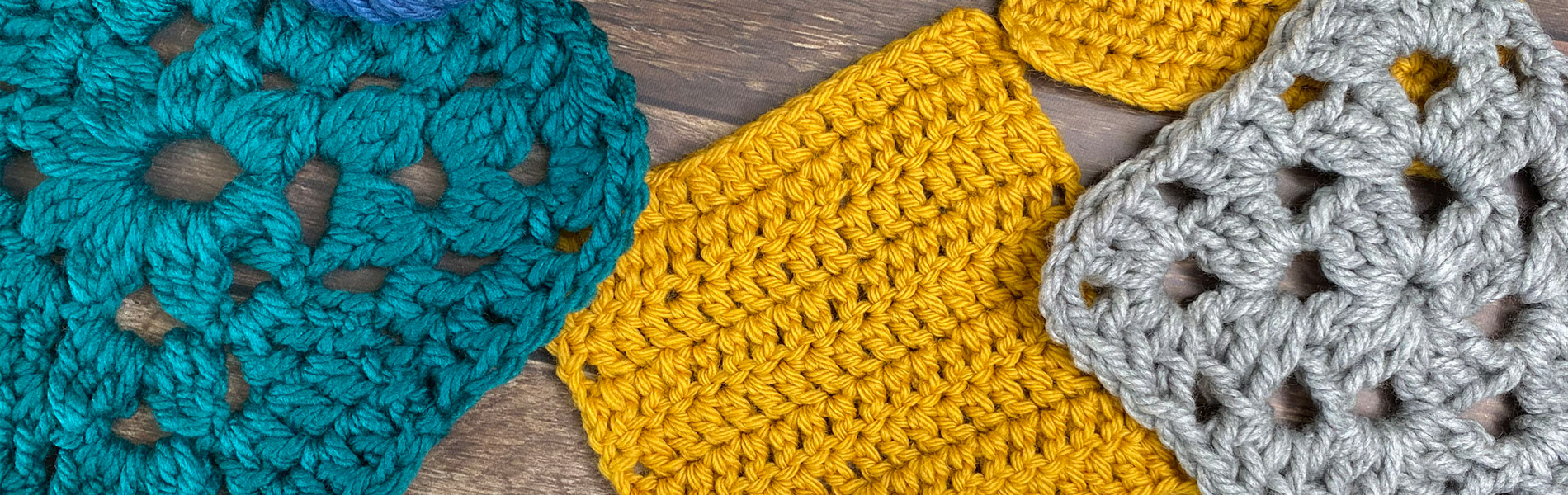
Wonderland Hooded Gaiter
Brenda K.B. AndersonThis winter accessory means business when it comes to beating the cold. Brenda K.B. Anderson demonstrates how to make a cozy hooded gaiter featuring stretchy slip stitch ribbing and the beautifully textured alpine stitch. With multiple ways to wear it, hood up and gaiter pulled over the nose for maximum warmth, cinched tight against the chill, or worn loosely around the neck when you need to cool off, you’ll stay warm, comfortable, and stylish all winter long! Click here to download the free pattern.
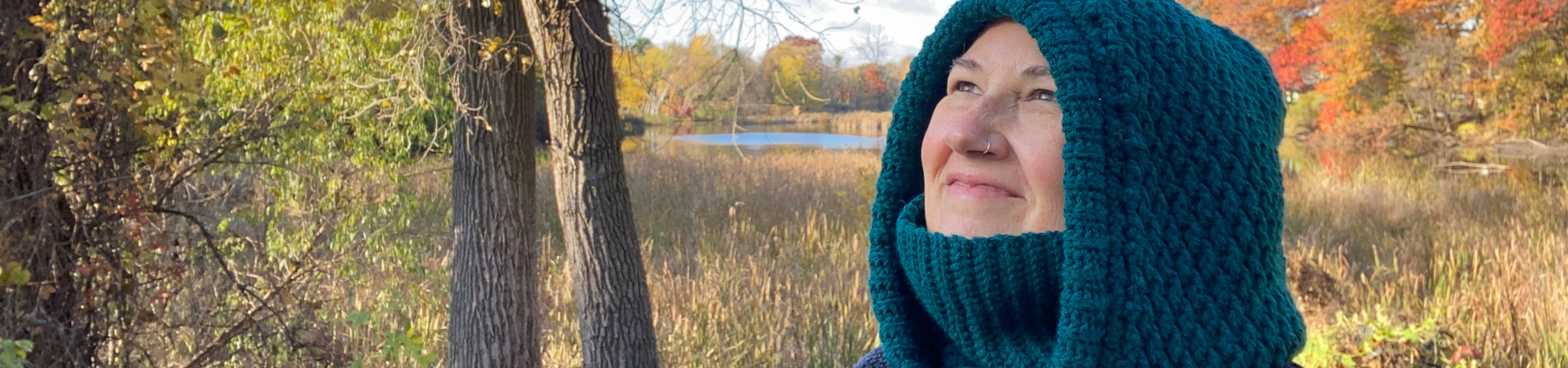
Hi everybody, welcome to our live event. My name's Brenda Kay Anderson. I'm a crochet designer and instructor, and today I'm gonna be showing you guys how to make the Wonderland hooded gator. So this is what it looks like over here. I'm gonna just pull this off of our little model here.
Um, and show you what it looks like flat. So we have just a hood and a drawstring, some little grommets here, so you can cinch it up close around your face if you like. And then if you take it off, pull it back behind you, you can see that there's the scarf that you can wear all the way up, um, over your over. Your ears even over your nose and so it's super super warm OK? It's like a double layered double layered hooded gator situation here and we've got we're gonna be um working this up in the alpine stitch which is this lovely textured stitch it has some nice stretch um and drape to it.
And then this stitch pattern is just stretchy ribbing that we're going to be making with a a variation of a slip stitch here. So I'm going to be walking you through all the steps you need to know in order to make this hood. Um definitely download the patterns you can follow along. Um, I'm not going to be giving out like stitch counts or specific rows or anything like that in this video. I'm just mostly going to be showing you like all the steps.
You're gonna be going through um in the order that you need to to work them up and I'm gonna be doing um some like a very small, much smaller samples so that we can kind of get through this in this one hour uh time frame that we have here today um so if you guys have any questions about anything I'm doing, um, if you have any comments, uh, if you have suggestions for future live events, I love it when you guys put that in the chat or if you just wanna say hi to me, um, that'd be great too. So this project I have to thank, I believe it was Laurie who suggested this. Laurie said that they would really like me to design something um that that could basically cover up everything on her head except for her eyes. So this is what I came up with. I really like the idea of making this sort of loose um hood that you could sit.
in closer if you wanted to and then that gator that pulls up over over your face so that way you can have all these um different options for like how cold it is outside. You can pull the gator all the way up and the hood and pull on the drawstring or if you're warmer you can scrunch down the the gator lower on your neck and you can pull the hood off and it could just kind of hang behind you, um, so that you got a lot of uh. A lot of different varieties of warmth here, uh, with this gator, this hooded gators. So, all right. Um, so let's talk about the materials that we're gonna be needing here.
I'll pop this back on my little head form here so you guys can see. It looks like All right, so I'm going to be using a worst of weight. It is the 80% acrylic, 20% wool. All of the details of exactly the color that I use, the brand, um, the exact yardage and all that can be found in your download, um, but I'm going to be using this worst of weight, which is this um a CYC number 4, number 4 weight yarn. And um so if you want to substitute with something else you could use 100% acrylic you could use 100% wool, you could use something with alpaca which is extremely warm, that would be really great um some kind of blend of any of those fibers put together is great.
You just want to make sure that you're choosing a fiber that has at least some kind of loft to it, at least some sort of squishiness and um you know, warmth to it, um. Like not 100% cotton or something like that, that would not work. Plus that would be kind of heavy. This is a very dense stitch pattern, so the acrylic and the wool, those are much lighter fibers than it would be in a, in a more dense fiber like a cotton. Um, I should mention that there are basically 3 sizes for the skaters, so there's a small, medium, and large.
The small is for like the younger, younger kids, uh, a medium will fit most adults and most like older kids up to adults because. Really our head sizes aren't really that different um from you know basically from kids up through like average adult and then there is a larger size and that's made for people who need a little bit of extra width around like maybe if you have a lot of like thick hair that you're trying to pull the gator over um then it would be a little bit bigger for you. Um, but also, besides those three sizes, I do have an option for a closer fitting hood. So this hood was designed to be sort of like a cloak, you know, a hood that kind of hangs down and sort of swoops around on your shoulders a little bit. If you want a, you know, if you're gonna be using this for, you know, like if you're going skiing or some kind of athletic purpose, you probably want to make the smaller hood just because it's not gonna move around in your head as much um this is just sort of meant to set on top of your head if you're, you know, going for a walk in the woods or whatever.
Kind of lower impact exercise outside um but that there just know that there are options written throughout the pattern for making us a closer fitting hood. It's not, I wouldn't say it's close fitting, but it definitely less um less fabric in it than the version that I'm gonna be showing you um right here. OK, so besides the yarn, oh, so you're gonna need about, let's see, somewhere between 660 and 770 yards. So that would be for the larger hood, for the smaller hood, you'd need less than those. Um, it just depends on what size you're working up.
And then you're gonna need two different size hooks. I'm using a G hook, which is a 4 millimeter hook, and that's going to be used for the ribbed gator, um, for, sorry, for the gator section of it, the ribbing. Um, kind of the neck warmer thing on the inside, and then the rest of it, so the hood and then the ribbing that goes around the face, that's going to be a 5 millimeter hook, which is an H. That's what I, that's what I'm using, but you can use whatever hook you need to in order to get the same gauge that I've listed in my pattern. I also do have instructions for making the gauge swatch and the alpine stitch pattern if you'd like to follow those.
Um, I'm not gonna be showing you how to do those because you can watch, uh, the my. You know, the, the alpine stitch pattern when we get to that point in this project, um, we just don't, I don't have enough time to do every single part of this, um, so I'm giving you all of the information from beginning to end of all the different steps you need and the stitch patterns and all that stuff, so. Um, OK, and then stitch markers are also very helpful for marking the beginnings of the round or the ends of your rows. Also, we're going to be doing just a little bit of seaming, um, just, I think, yeah, just one seam where we sew a little bit of ribbing into the hole that's for the face. Um, and so the stitch markers are useful to use as pins at that point as well.
If you don't have stitch markers, you can use safety pins or something else. Um, that worked just fine. And also we're going to be using these grommets. So these are hammer in style grommets, um, and I did put a link in the pattern download so that you can see exactly what I'm using here, but these, these are the grommets I'm going to be using. So each grommet has two halves, OK?
Um, the half with the sort of height to it, the thickness, for the thickness of the fabric, and then the, the sort of flat doughnut shape other half. That's what we're gonna, we're gonna be using this size, which I think it's a half inch size. Let me just double check here. 0, 3/8 inch inner diameter. OK.
So that's the inner diameter, um, from one edge to the other of the inside hole of this, this gromit. So that's the size we're going to be using and also you're going to need a way to set the grommets. So this, the, this whole kit is what I linked so you can see exactly what I'm using here. You can see the tools that I'm using um and and the grommets as well, but you can certainly substitute with a different grommet, you know, if you already have grommets or a different way of setting them, that's perfectly fine too. If you are not interested in using the grommets, um, You can do this without the grommets, you can just leave one, like a little hole, make a chain space in your ribbing, so.
And in this little section where we do the ribbing back and forth and turn rows, you can just make a little chain one space here and here like near each end of this ribbed section, and I'll talk a little bit more about this later um and then you could just not use the gromme. I feel like it the gromme just sort of adds to it just looks a little more professional and also um when you're pulling on those drawstrings, it's not gonna sort of eat away at the the yarns, the space that it's slipping through if that makes sense. Um, and then you'll also need a safety pin of some sort. You could probably use a stitch marker for this if you don't have a safety pin, um, but I'm gonna be using this to feed my drawstring through the, through the ribbed this little ribbing section. So we're gonna feed a little drawstring that we that we crochet through, through those holes, so.
Um, let's see. I think that's it for materials. Oh, and you'll need a hammer to set in your snaps if that's the way that you're, uh, not sorry, not snaps, your grommets. Um, so I've got my little hammer here as well. OK, so let's see.
What yarn did I use? OK, so the information for the yarn, the brand and everything is found in in your download. I used um. Let's see, this is wool ease, a worst weight wool ease, and then the sample that I'm using today, this is impeccable. I feel like the wool ease, if I had to do this again, I would use the woolies because I feel like it was a little bit more warm and plump.
I like that one a little bit better, um, but all the details, everything, that's all in your download, um, so you can check that out if you want to know like color numbers, exact, you know, all the information, um, about the yarn, so. Let's see. Oh, and we've got a hello from Austin, Texas. Hi, Rita Orretta. Hello.
Thanks for saying hi. Oh yes, and, uh, Becky is saying that would be most welcome in Alaska's cold and windy winter, yeah. Certainly would. That is, uh, yeah, I, I feel like, you know, as much as Minnesotans complain about the cold weather, the, the, the cold here is nothing compared to Alaska. OK.
So let's get started, um, working up for a little. Uh, rib rib section here. So actually I'm going to pull this in here so you guys can see where we're going, so you can see the steps that we're going to be taking. So when we start this out, we're going to be working on the ribbed section first. So we're going to be working this section back and forth in turned rows, OK, like this, and we're going to make a long rectangle, and then we're going to put that rectangle into a tube.
And then after we make our tube, then we're gonna be working the alpine stitch in the round here, and then we're gonna start working the alpine stitch back and forth and turn rows. So in order to make the stitch pattern look the same when we work in the round and work and turn rows, we are actually going to be working. The part that's in the round in something called joined turned rows. So we're really the stitch pattern is worked with right side facing, then wrong side facing, then right side facing, but we're joining our rounds and if that makes no sense to you, that's OK, we're going to get to that. Um, I just kind of wanted to give you guys a little preview of where we're going.
OK, and so, and this chunk, you know, is all made in one piece and then we're going to make this little ribbed piece that I showed you earlier. This is to um kind of go around the hole and for the face, and that will get stitched in. So. Um, and then the other little piece we're making is the drawstring, which is right here. OK, so we're going to start out with the gait, the ribbed section, and we're going to be working that in something called slip stitch through the back loop only, or actually yarn over slip stitch through the back loop only.
So we're going to grab the smaller hook, um, and you know, you can go ahead and do a gauge swatch. I do list, you know, what, what my gauge was for the ribbing and also for the alpine stitch, and you can go ahead and check that first. Um, you can also If you're feeling daring, you can start working on the ribbed section first, but make sure you actually are measuring that at some point, because you want to make sure that you're really getting this to be the size that you need it to be. OK, so we're gonna place a slipknot on our hook. And then you're gonna change the appropriate number of stitches.
I believe it's something like 48 stitches or something like that. Let me look. But in this, just for the purposes of showing you how to make these um pieces, I'm not going, I'm not gonna be doing a full size, oh yeah, OK, so you're gonna be either chaining 44 or 49 stitches just depending on what size you're making. And if you do need some help learning how to read a pattern, I do put a link in your download so that you can watch another video where I explain to you how to read a crochet pattern, how to follow a pattern if um if that's something that's new to you. OK, so we're just gonna change some just to get us, you know, a little section so you can see how to work up the stitch pattern, but if you were making this, you know, this git, you'd be chaining, you know, somewhere between 44 and 49 chains.
All right, that looks pretty good, um, for me. So your chain would be much longer. It would be, you know, as long as your gait is going to be tall, because you're working it sideways in turn rows. And now we're going to start in the 2nd chain from the hook. So and we're going to work into the bottom of the chain.
So if you lay your chain on the table, you can see there's a whole bunch of V's all stacked up like this. If you roll those over so the V's are touching the table, you'll see these little horizontal dashes on the back of the chain, and that's where we're going to work on. So we're going to skip the very first one. We're going to work under the 2nd 1. So we're going to make a yarn over and then we're going to insert our hook, and we're going to yarn over again and pull up a loop and then we're going to continue pulling that same loop through the two loops that were on our hook.
So this, this is different than a half double crochet. I think people oftentimes get a little confused because it starts out looking like you're going to do a half double crochet. Um, but we're doing one fewer yarn over than in a half double crochet. So just make sure you, you take your time and actually watch what you're doing because if you're someone who's crocheted a bunch before and you've done half double crochets, you might accidentally just start doing those. OK, so you're gonna yarn over, insert into the next chain, yarn over, pull up a loop, and continue pulling that loop through the two loops on the hook.
So let's do that again. Yarn over, insert, yarn over, pull up, and pull that same loop through the two loops on the hook. Yarn over, insert, yarn over, pull up, and pull through the two loops on your hook. So we're going to do that all the way across our foundation chain. And, you know, if you're having any trouble get working into this chain, if you're a little newer to crochet, sometimes you can just make your chain with a hook that's one size up, and then switch to the smaller hook to do your first row, that can sometimes help.
It's very common. It's, it's, I can say though that it is easier if you're having a hard time getting your hook in, it's easier just to pull it out and make the chains again, cause you can make chains fairly quickly, but working into chains that are too tight is very frustrating. It really does slow you down. OK, so here's my last stitch that I have. You will have worked all the way across your chain, so you'll have, you know, a much longer piece.
And we're going to chain one, turn our work just like we're turning a page in a book, and now we're going to start doing the yarn over slip stitch, but we're going to work underneath just the back loop of our stitch. So what that means is, um, so this is where we would insert our hook to make our stitch, and normally we go underneath both loops, both loops of that little V on top, but now we're going to go under just the back loop, which is right here. All right, so we're gonna yarn over, and we're not gonna work into that turning chain. That turning chain doesn't count as a stitch. We just make the turning chain at the ends of our rows, and then we just forget about it.
And then we're going to work a yarn over and then insert through the back loop of that very first stitch. Yarn over, pull up a loop, and pull that same loop through the two loops on her hook. Yarn over, insert through the back loop, yarn over, pull up a loop, and pull through the two loops on her hook. Yarn over, insert, yarn over, pull up, and pull through the two loops. All right, so we're just gonna continue making this, this is called the yarn over slip stitch through the back loop only, or through the back loop.
We're gonna work this all the way across our row. And working it through the back loop that allows it to be stretchier. It also gives it that ribbed appearance. So you'll start to see those little ridges appearing as you work a few more rows. All right, now we're at the end, so we're going to chain one, and I like to do those chain ones pretty tightly.
You're never going to work into them. So working them pretty tightly just makes your edge a little bit tidier. And then we're going to turn our work and we're going to do the same stitch. So yarn over, insert through the back loop, yarn over, pull up a loop and pull through those two loops on the hook. Yarn over, insert.
You're an overp pull up and pull through 2. You're an over insert, you're an over pull up and pull through 2. And if you're having trouble with your stitches getting to be too tight, this sometimes happens when when people are working up slip stitches, then really slow down and see where your loops are getting tight. If you go through, get that loop and if you pull through here and and pull. Too much in this direction.
Sometimes this loop will get smaller. See, you can see how that loop is getting tighter and tighter right there and it gets a little bit harder to work into. Normally the yarn over slip stitch to the back loop, only that one isn't quite as problematic as a regular slip stitch through the back loop. So if you've done a slip stitch pattern before and you've gotten frustrated by working through that back loop, um, this one is a little different, so, you know, don't, you know, don't let that scare you away. And this stitch pattern, you know, it does take a little bit of time because it's not a particularly tall stitch pattern.
You know, it's not like we're doing a half double crochet or a double crochet here. It is a fairly short stitch. It's probably about the size of a regular single crochet, maybe even a tiny bit shorter than that. Um, so it does take, you know, you do have to have a little bit of patience, but the fabric that it makes is very stretchy and it strings, springs back into shape really well and it looks really nice. Um, so I find it to be completely worth it, and this is only a section of your cowl, you know, this is just the neck part of it.
The rest of it will be in that fun textured alpine stitch pattern. All right, so you're just gonna continue working this rectangle back and forth and back and forth and turned rows, um, until you have worked the amount of rows that are in your pattern. Let me just pull that in here. Let's see. So you would be working either 72, 80 or 88, um.
uh, rose, and then once you've done that, then you can turn it into a tube. So we're just gonna pretend. This is a tiny little sample here, you know, it would be much wider. It will also be much, much longer, and we're just going to pretend that we've reached our appropriate number of rows for our size. So let's just say we just finished up working that very last stitch, then we would chain one, turn our work as if we're going to work another row, and then we're going to bring that foundation chain up in front of the last row we worked, OK?
So they're just folded. This piece is folded, so you've got one edge right on top of the other, and we're going to slip stitch seam these together. So what that means is we're going to be going underneath the back loop of the edge in front and the back loop of the edge and back and making a slip stitch. So we're going to insert our hook here into the back. And right here under the back of the row behind, grab that yarn, pull through, and pull through that loop.
So again, go through the back loop, back loop, grab that yarn, pull through, pull through. Insert, insert, grab that yarn, pull through, pull through. So we're not doing a yarn over slip stitch here. This is just a regular slip stitch. So we're gonna insert, insert.
Yarn over, pull through, pull through. OK, so this is going to seam our, our edges together to create that tube shape. And you can go ahead and try this on. I would definitely recommend that, um, or you can measure it to make sure that it's turning out the size that you had intended or want it to be. Because if you continue without checking and then later you, you know, you try it on at the very end, um, and it, it's too loose or something like that, it might be frustrating.
So it's good to do that now. I like to try things on and test them out as I go all the time. I feel like it really helps, you know, just helps you feel confident about the size and shape everything's turning out. All right, so we've got that slip stitch seam right there. We're going to leave that on the outside of our work and we're gonna just open this tube up and we're gonna work around the top edge of our tube.
So later on, this tube will get flipped to the inside of our gator, um, and we're not going to see this seam, so don't worry about that. OK. So now, at this point, we're going to switch to a hook size that's 1 size larger. So I'm gonna bring in my H hook. This is a 5 millimeter hook here.
And then I'm gonna chain one right here, and then I'm gonna start working double crochets all the way around. So if you take a look at your ribbing, you'll see that you have these sort of ridges, like, here's a ridge, and then there's a little groove right before it. So groove, ridge, groove, ridge, groove, ridge. We're going to be making a double crochet into each groove and each ridge around if you're making a size small or a size medium, OK? If you are making a size large or if you're making the the smaller circumference a closer fitting hood, then we're going to have a different approach.
So let me explain that approach before we move on. Let's see. Yep. OK. So this is all written out in your patterns, so you, you know, you don't have to remember exactly what I'm saying, but I just want to make sure that the that this is going to make sense to you when you get to this part.
So if you are making one of the closer fitting hoods or if you are making uh the size large, then what you're going to do is you're gonna. Divide the top, the top edge of your tube, your gator, into 4 equal sections. OK, so we're going to count this beginning loop here. That's going to be 1 point, and we're going to fold it flat, so that's at one side. So there's our loop, and here is the opposite edge.
We're going to place a stitch marker directly across from that loop. Like this. And then we're going to open this up again and match up the loop with our Our stitch marker. OK, so they're right on top of each other and now we can place another just randomly have a bead here. OK.
And then you can place another stitch marker in the folded edge here and then one directly opposite that marked st or marked area right over here on this fold. And that will give you 4 equal sections if you, you know, if you're looking down on this cuff here, you can see them 123, and 4, OK? And then you're going to just evenly distribute your stitches in those sections. Now, your cowl, of course, is not going to be this small. This is very tiny.
This is like if I was making it for the bubo or something. Yours is gonna be quite a bit bigger. So, you're gonna have a longer space to go, so you can further divide the space between your stitch markers if you'd like to, if you feel like that's gonna help you keep on track, you can go ahead and do that. Just make sure you know, um, You know, you, if you're going to further divide them, divide each section in half. OK, so put one here, here, here and here.
And then you're gonna divide the stitches that I tell you go in in um section one. So for example, um, let's see, let's just say you were making a smaller, closer fitting hood for a size small or medium. OK. And then you would make 15 or 17 double crochets into each marked section once you divide it into 4. So, for the smaller size, you'd make 15 between each, you know, each marked section.
If you're making the medium, you'd do 17 in each. March section, but if you're gonna further divide those in half, you know, 15 and 17 don't exactly divide in half, but that's OK because you can just divide that mostly in half. So it'd be like 8 stitches in one section and 7 in the next, and then together those make 15. OK, so you know it doesn't have to be perfect is I guess what I'm trying to say. So then when you're working your stitches up.
You're just going to kind of eyeball that like you know if you had a certain amount of stitches between here and here you just start working across and making sure that you can fit that amount of stitches in between here and here. Now if you are making the looser fitting hood like I'm showing you, you know, the one that's in the picture. the one that's in the sample, kind of I call that the standard looser fitting hood. If you're doing that, you don't have to mark this because it's much simpler for you. You're just going to place a a double crochet into each ridge and each groove, OK?
So you would just to do a double crochet, you would yarn over. And then we're going to insert in this in this groove here. You're an over pull up a loop, you're an over pull through 2, you're an over pull through 2, and that is our very first stitch of the round. Regardless of which method you're using to space your stitches, you're going to place a stitch marker there just so that you know that's the first stitch of the round. And then we're going to do uh an uh double crochet in the next ridge.
OK, so that's right here. So, there's our double crochet, and then we're gonna do a double crochet in the edge between our ridges in that little valley there. And then we're gonna do one here in this ridge. OK, so each, each of those ridges or valleys between each of those gets one stitch. Each of those is one row actually, so we're working one stitch into each row end and remember you're, you've switched to that larger, larger hook size.
All right, so I'm just gonna continue placing one double crochet into each ridge or valley all the way around. Um, and if you are making one of those other sizes where you divide it into 4, you already know how many stitches you need to make, and you don't have to worry about placing a double crochet into each, you know, each row end, you're just going to kind of evenly distribute them across the edge. I do find though that if you work into those ridges, it really looks nice. So I don't normally skip the ridges. I usually skip the valleys if I don't, you know, if I'm.
If I'm making one of those um sizes where you're dividing the top into those 4 equal sections and you have to count out your stitches. So I'm just placing my hook into an area that lives close to the edge and where it looks nice and when I make the stitch, if it, you know, it doesn't pull into a bigger hole, like if it doesn't cause a big hole to happen, then it's fine. If it does create a larger hole then try a different spot, maybe look for a spot with your hook that's a little bit tighter of, you know, like a little bit more densely stitched area, then that might look a little bit better. But it's really not, you're not looking for a very specific spot to insert your hook. It's not like it has to be under this loop or under that loop, it's just kind of in the edge.
All right. I'm gonna catch up on my comments here while I'm doing this. Oh, we've got a hello from Austin, Texas and. So cozy for Wakadogo. Yep.
Maybe you should make one for your dog. Just kidding. I'm sure your dog would probably not like that very much. And you're welcome, Margaret. I'm glad you love it.
OK, so I've gone all the way around to that very last groove between ridges here, and now I'm going to make a slip stitch in the very first double crochet I made, which I had marked. So we're going to make a slip stitch here, so we just grab that yarn, pull through, and pull through. Then we're gonna chain one, and this is where we start doing those turned rounds that I was talking about. So we chained one and we wanna work back and forth as though we're working this flat, but we want to work it in a tube. So when we do that we join and then we turn.
And then we're just going to start working in this direction for this round. Now this right here, we're going to skip this stitch or this chain right here because that's a turning chain. We're also skipping this little chain here, right here, because that was our slip stitch joint. That doesn't actually count as a stitch. We're not going to work into it.
So we're not working into this. We're not working into this. So that's 2 things to skip, and we're going to work right here into that very first stitch. And we're gonna make a single crochet. So we're gonna do a single crochet in each stitch around.
So there's our first one. And we're gonna create a single crochet in each stitch around. Now, just, you know, keep in mind, this is gonna be much larger because you're making it for a a human. But we're just placing one single crochet into each stitch. Around Just have a few more stitches left.
All right, so your last single crochet should look like there's something kind of worked into it a little bit because that's where you had done your slip stitch join. So we're going to, you know, that's how you know you're in the last one. So you do your single crochet there and then we're going to make a slip stitch joint into the very top of that first single crochet. So here's our slip stitch joint. That's not going to count as a stitch.
We're going to chain one and turn. That's also not going to count as a stitch. So we skip that turning chain, skip that slip stitch. And we are going to start working in the post-stitch pattern. So in order to work in the alpine stitch, we're going to be working in the row below that single crochet row sometimes and then sometimes into that single crochet row.
So let me just double check and make sure we're starting out with the right stitch. OK. Yep, the row below. OK, so when we're in round number 3. Of the hood so we're going to be working down here in this around this post so to know where we're at, so we're skipping, we're skipping that chain that turning chain, we're skipping the slip stitch.
This is the single crochet that would we would be working in, but we're really going to be dropping down here directly below it. And we're going to work around this post. So to do that, we're going to yarn over and we're going to insert from right to left around the back of that post. We're going to yarn over, pull up a loop, yarn over, pull through 2, yarn over, pull through 2. OK, so that is called a front post double crochet.
And then after that we're going to make a regular double crochet into the row of single crochets. So if you look at the row that you would be working in, we're skipping that single crochet because we worked a post stitch down in front of it. So that counts as though we worked that stitch. So now we're going to work into that next stitch and we're going to place a double crochet. So yarn over, insert, yarn over, pull up a loop, yarn over, pull through 2, yarn over, pull through 2.
Now we're going to do a double crochet in the uh a front post double crochet in the row below, which is down here. OK, so this is that that double crochet row that we had done. So we're going to go from right to left around the back, yarn over, pull up a loop, yarn over, pull through 2, yarn over, pull through 2. If you are a left-handed crocheter, um, you can flip your screen or watch it flipped, and you'll be inserting your hook, you know, from left to right around those posts. All right, now we're gonna do a double crochet in the working row.
OK. So again, we're skipping the stitch behind the post stitch that we just made. So there's our double crochet in the working row, and then a front post double crochet in the row below. So a double crochet in the working row, a front post double crochet. In the row below.
OK? So we're working in the working row here, and then we're reaching down and working down below into those double crochets. So we're just doing every other stitch. I'm just alternating all the way around. All right, I'm just gonna add a little piece of yarn because I'm running out.
All right. So this is me. This is how I like to add my yarn sometimes. I will just kind of lay it along with what I'm working on and just stitch with it. Stitch with both of them for a couple of stitches.
So, here's my double crochet in the working row. And it is a little thicker, but like for one stitch like that, it's not really very noticeable, and that really anchors your yarn really well. It's not gonna slip out as you're stitching. And you have less weaving in to do later, you should still weave it in somewhat, but you know it does help everything kind of stay in place. But you can, of course, add your yarn, however you like.
I just wanted to explain what I was doing cause it's not always the way that people do it. OK. So we're still alternating back and forth between doing that front post double crochet in the row below and working a double crochet in the current row, that single crochet row. And here is our last. Double crochet.
Right there. OK, so you should end with a regular double crochet in the current row, and then you're going to do a slip stitch into the top of that front post double crochet from the row below, that very first stitch you did in this round. Let's do our slip stitch here, then we're going to chain one, and we're going to turn our work. So we're skipping the chain one, we're skipping the slip stitch, and we're going to work a single crochet into each stitch around. So when we work those double crochets in the working row, they kind of get squished down a little bit because our, our postages in the row row below kind of pulls your fabric down.
And that creates a warmer fabric. It's a little bit thicker. Um, than usual, you know, even though, like, even thicker than just a normal post stitch fabric, I feel like because it's kind of being squished down. All right. And then your last single crochet should be in the stitch that kind of shares that slip stitch.
All right. And then we're gonna do a slip stitch to the very first single crochet of the row. Let me see here. Yeah. So that's right here.
There's our slip stitch. We're gonna chain one, and we're gonna turn our work. Now, in the last post-stitch row that we did, we started out with the front postage in the row below. This time, we're gonna start out with a double crochet into Our working row. So we're going to make uh uh yarn over, insert, yarn over, pull up a loop, yarn over, pull through 2, yarn over, pull through 2.
OK. So there's our very first stitch of the round is a regular double crochet in the working row. Now we're going to do a front post double crochet in the row below, which is right here. So these are the double crochets now that we worked on the row when we first started alternating between double crochets and those post stitches dropped below. OK.
So we made these double crochets then. And now we're going to be working a post stitch into all of those double crochets. So, double crochet in the, the row, uh, the working row. So that would be into one of the single crochets. Then we're gonna drop down and make a double crochet into the double crochet from the row below.
Double crochet in the sin into the single crochet row. A front post double crochet into the round below. OK, so now we're alternating. But because we started with a double crochet instead of a double crochet in the row below, these are offset from the last um round of postages that we had done. So here's a postage here there's there's a postage there and there's one kind of like situated in between in the round that we're doing right now.
So that's how you know that you're getting your postage is in the right spot. It should be between the post stitches that already existed from, you know, a couple of rows before. All right. So in your pattern, you're going to do a few rounds of excuse me, of doing these joined turned rounds. And so after you've done, I think it's like round 6 or so, um, you'll just have to refer to your pattern, but after doing a short amount of joining and turning, that's when we're going to start separating and just working back and forth and turn rows and leaving a spot open for, you know, where your face will be.
So let me get around here and we'll talk about that a little bit here. And here is our last double crochet in the round below. And then we're gonna do a slip stitch join to that very first double crochet we made of the round. Like that, and then we chain one, and we're gonna turn our work. And then we're gonna do single crochets.
And then the next round we do, so this is where we start doing the repeats. The next round we do after this round of single crochets, our post stitches will line up directly above from the very first round of making those dropped post stitches, those those post stitches in the row below, so they'll be directly above that. Um, but I want to jump ahead just a little bit, um, because once you've turned back and forth and back and forth and turned rows, there's going to be a, there's a little line in your pattern that tells you where to place some stitch markers. So, let's see. Separating right and left sides.
OK. So, I want to call your attention to, let's see. Oh, not quite there yet. OK. So there's a section beginning on page number 6 where you are working, you're, you're asked to place the markers.
That's what the PM stands for in your, in your pattern. So you're going to work, you're you're following this pattern, the same alpine stitch pattern. You're going to start with that double crochet in the room below, and then you're going to do a double crochet, and you're going to do that a certain amount of times and you're going to place two stitch markers in the postage just made. That's what it says here. And then you're gonna do some more repeats, and then you're gonna do another um Uh, you're gonna place another, another stitch marker in the postage that you made, and then you finish up your round.
So, let's just, actually, maybe we'll just Get to that section. We'll just get to that section so that it'll make it a little bit more clear to you. I'm gonna just kind of speed along here and finish this single crochet around. And we are actually going to be. Let's see, where's the end of my round here?
Oh, almost there. OK. There's my last single crochet. I'm going to do a slip stitch, chain one, turn my work, and now we're working that round that I was just talking about, round number 7. So this is where you place some stitch markers, and that's going to show you basically where the opening is for the front of the face.
So it tells you how many stitches to repeat. So we're going to start out here working that post stitch in the row below. And then we're going to do a double crochet in the working row, a post stitch in the row below. So this is still continuing in that alpine stitch pattern, and it's going to tell you a certain amount of times to make to repeat the sequence of working below, working in the row above, working below, working in the row above. OK.
And then at some point it's going to tell you to place a stitch marker in the in the stitch you just made. So let's just say, That stitch would be here, so we're gonna be doing uh a post stitch in the row below, and then we place a stitch marker into that stitch. That we just made and then we do a few more stitches. In the stitch pattern. So we're still working that double crochet in the working row, postage in the row below.
Double crochet in the working row, postage in the row below, and then it'll tell you to place another stitch marker. And that stitch marker, again, is going to go into one of those postages worked into the row below. OK? So you'll have a little space between your stitch markers of a number of stitches here. And then you're gonna continue till you get to the end of the round, and then you will slip stitch, and then you will fasten off.
So, let's just say. Where's the end of my round? Oh, it's way over there. So I'm, I'm gonna just fasten off here, but let's just say we were getting to the end of our round, we would just slip stitch into the first stitch, and then we would go ahead and just cut our yarn like this. OK.
Um, I didn't finish that round, but you would have. All right, so you've got these two stitch markers. This is actually where you're going to start creating your, um, The the face hole, basically. So on the next round, because we finished with a round of doing our post sages, on the next round, we are going to begin, um, at the very first place, let's see, the very first stitch marker we placed, we actually placed two stitch markers, sorry, I forgot to do that. Um, the first time we were asked to play stitch markers, we placed 2, and that's so we can differentiate between this stitch marker and this stitch marker.
So when you start working back and forth and turn rows and you're not joining anymore, you're going to start right there where your double stitch marker is and you're going to pull up a loop. In that sketch Like this. And then you're going to make single crochet and work all the way across. So you're gonna work around. Excuse me, around the back of your piece.
And you're gonna go across where the beginnings of your round used to be. We have actually now changed the beginnings of our rounds to the place opposite of where they used to be. If you noticed, we, we did a number of stitches and then we placed the stitch marker and we placed a second stitch marker and then we finished at the end of our round and then we fastened off and then we joined. OK, this isn't looking, this is, I hope that wasn't confusing because I only worked a partial round there, so hopefully that wasn't too confusing, but you're gonna end with your single crochet. Your last single crochet is going to be into that marked stitch, OK, right there, and that's what's gonna tell you that the, you know, this section here we're gonna work this back and forth and back and forth, OK?
So you would, you know, chain one and turn, and then you would create, you know, it'll tell you when the pattern whether you start with a double crochet in the first stitch or what I think it is actually double crochet in the first stitch and then a double crochet in the round below and you're still continuing in that alpine stitch pattern, OK? And then working in the round below. So you're just going back and forth. And now, instead of joining, you're not gonna join any longer, you're just going to turn your work and follow in that stitch pattern. So you're gonna go back and forth and back and forth for quite a while.
Let's see. Your piece will look something well something like this, but of course much, much larger. So these were the places we had marked off for, you know, the, the, the point at which we were going to leave that open. This is the face hole here and then we've worked this back and forth and back and forth in those turned rows continuing in that alpine stitch pattern. And then there's going to be another little section where it's telling you to place some stitch markers once again.
So that section, let's see, is for dividing, that's separating the right and the left sides of the hood. So if we look here at row number 34 or 38, just depending on what size you're working on, you're going to place a stitch marker in the 26th or the 30th. Um, you're gonna place one stitch marker there and you're gonna place two stitch markers in the 40th or the 44th stitches as you work your way across. So when we're working our way across this row, we're repeating row 2, which is um where we start with a double crochet and then do a front post double crochet in the row below. So what that means is we're going to, we're still continuing to work in our stitch pattern.
And we're gonna start with that double crochet. Right here, and then we're gonna do a front post double crochet. And we're counting our stitches, OK, as we do this, or if you can't count as you're doing this, you can kind of stop every once in a while and check in and, and make sure that you know where you're at, um, and then you're going to be placing your stitch marker into the, like I said before, into the. 26th or the 30th stitch that you make. So, let's just say, you know, because this is a very, very small scaled down sort of swatch version of what we're making.
It's going to be somewhere close to the center back, but like a number of stitches away, maybe like 5 stitches away or so. So we're gonna place the stitch marker here, and then we're going to chain one and turn. Oh, actually, sorry, not, not yet, not until the next row. OK, yeah, sorry, this row is, um, with the right side facing, we're just going to be placing those stitch markers. We've got to work all the way across the whole thing placing those stitch markers.
So you would put them in, you know, if this was a size medium, you'd put them in the 30th stitch. Which would be in a post stitch. Make sure it's post-stitch. And then you'd do a few more stitches until it tells you to place your second marker. And let's say.
Place that here. Place your 2nd marker. OK, which would be in another post stitch, and then you would continue your way to the end of the row, just continuing in that working stitch pattern. So, what these markers are gonna tell you, these markers are going to be telling you where you're going to be shaping the back of the hood. So, which sounds complicated, but it's actually very easy.
You're just going to be turning your work at that marker. So, let me just kind of get to the end here. And I'll show you what I mean. Whoops. All right, here is my last double crochet of the row, chain one, turn my work, and then we're gonna be working a single crochet into each stitch, and we're gonna land with the the last single crochet in that marked stitch, that the first one we come to.
All right. So here's that marked stitch. That's where we're gonna stop. And that's telling us, we're just gonna work back and forth on this little section for a while. So you continue working in that Alpine section.
I think there's maybe like 6 rows or something here. And then you fasten off and then you will come back with the wrong side facing and begin by pulling up a loop right here in that other marked stitch and you're gonna work that section back and forth and back and forth in those turned rows and then fasten off. And so what we're creating when we do this, we're just making this little section at the very top of the hood. Here, I'll turn it this way so you guys can see. This is, so this is the face.
It's, it's laying sideways on the table. This is going to be the top seam in the hood, and then here's like this little back cut out. So, once we create our piece, We've got this little notch in it and we can sew our pieces together. We're gonna steam them together. So you can just kind of abut those two little edges and do a little whip stitch, and I like to sew across the top of the hood first, and then I go back in and I kind of make this little dart in the back of the hood.
Oops, I don't want, I want a blunt tapestry needle. Here, I grabbed the wrong one. Here we go. Oh, may I ask what part is she working on now? OK, so right now I am working on the very top of the hood, so we've got the ribbed gator part and then this is the hood.
Here is the front opening of the hood right over here and then I'm gonna be seaming the very top. Of the hood together. OK, so actually I'm gonna hold it this way. And I'm gonna do a whip stitch. You could do a mattress stitch, you could do any, any seam you like across the top of the hood.
And you can go ahead and if you want to you can pin your pieces together. I don't normally do that because I know it's a 1 to 1 stitch ratio because they they have the same amount of stitches on both sides so I'm just careful to put my needle underneath, you know, the next stitch from each edge and so I don't bother with the pinning, but if that helps you, you can use those stitch markers to kind of get things pinned in place, um, so you can make sure everything's getting matched up OK. And you could do a slip stitch seam or something like that here if you really do not like some people don't love doing the sewing part of finishing projects, um, but I like how this lays nice and flat so that's why I chose to do whip stitch seam here. I like how you can abut those two edges and it just lays really nice and flat. Oh, when I did actually, I should mention I did actually steam block this piece.
Once, when you are working this up, you're working it up at a fairly tight gauge, not, you know, the gator itself, the tube that goes around your neck has worked at a quite a tight, tight gauge. The hood is a little slightly looser, but it's still a pretty firm gauge compared to how I normally, um. You know, normally on, on a worst of weight yarn I would use like probably H or an I, um, but for something with with post stitches I might even go up another hook size if I wanted it to have more drape, um, but because I wanted it to be nice and warm I kinda, I'm, I'm we're using an H hook which is a 5 millimeter hook, um, because I wanted to keep the holes from being. Too large, you know, I just want to keep it nice and warm. So then it becomes extra important to do a little bit of steam blocking, especially if you're using an acrylic, or you can do wet blocking if you're using a wool because that's gonna help your fabric have nice drape and kind of fill in those holes even a little bit more.
All right, so we have reached the front of our hood. I'm gonna go ahead and just Sort of weave this in real quick. I would probably take a little more time to do this, but I'm trying to save time here to make sure I can show you guys all the steps. All right. I'm gonna cut that off, and then we have this little section at the back of the hood that needs to be seamed, and we just happen to have a little yarn tail here.
If you didn't, you could just grab another strand of yarn and just start sewing, and then weave in both ends later. So with this we're sewing the this edge of our stitches to the sides of our rows here, but that that's perfectly fine. We just need to kind of um you know, this, this actually might help since it's not a 1 to 1 ratio, it might help to just throw in a little stitch marker here in the middle just so you can make sure that it's evenly distributed. And we're gonna go ahead and do a little whip stitch across this edge as well. And you can do this with right sides held together, or you can do it um right side out, which is how I'm doing it.
The the wrong sides are held together. That's how I'm doing it here. Either way works just fine. All right. Just a couple more stitches here.
And then the next thing you're going to do is you're going to create that ribbed band that goes around the face opening. So lucky for you, you already know how to do that. That is, that is just more of the same stitch pattern that we used when we made the gait. So you're gonna this time though, you're going to use the same hook size you used for the hood part. OK, so the hook, the larger of the two hooks that you're using in this project, and you're going to make just sort of like a long strip, but it's exactly the same.
Um, technique, the same way of making it as when you created this, which I showed you before. So you're gonna make a very long rectangle. It's gonna look like this with that yarn over slip stitch through the back loop only. And once you have finished that, you're gonna slip stitch seam them together. And we've already done that as well because um you guys did that same step on the gator, so we're just going to chain one turn as if we're working another row, gonna bring that foundation chain up in front and we're gonna do a slip stitch across all the way across.
So I'm just working again, I'm just working through that back loop of each edge. To make, make that slip stitch. In this seam, I like to put the seam at the bottom of the face, so it ends up actually being between the two grommets. So just kind of keep in mind. That's where it's gonna go, kind of down by your chin.
So, I'm gonna chain one, and I'm gonna open this up so that my slip stitch seam is actually on the inside. Now, we're going to consider this the right side of our piece. I'm gonna put a stitch marker in here. And then I'm gonna show you how to add those grommets. OK.
So normally I would do this on a cement floor. Um, because it really does help to have a nice solid thing to hammer into, so I take a little chunk of wood, this, this little chunk of wood, and I put it on my basement floor, cement floor, um, that works the best, but if you have a very solid work table, that's great too, just anything, um, so this might take me a little bit longer to get my grommets in just because I'm not doing it on a super solid surface. I mean the table's solid enough, but it's not, um, it's, it's no cement floor. So we're going to be placing these grommets in from the right side to the wrong side with this longer, the piece that has like the height to it, and I'm going to be putting it in, you know, 1 inch.5 or 2 inches away from that center seam, which is right here. Um, I'm just eyeballing this because it doesn't actually really matter um exactly how far from the seam it is.
It's just how far you want it to be just visually. And I'm going to place this in about 3 stitches away from the edge, and now we, we didn't actually make a space there because I wanted this to be very tight so the gromme can't come out. So I'm after 3 stitches, you can kind of see those 3 posts, I'm kind of just making a little hole there with my finger. You definitely want to, you know, do this with care. You don't want to actually break the yarn, but the yarns that I've chosen are quite stiff, and now you can make it just fit.
You just want to kind of push it through. And then we're going to add this section on top, the rounded side should be out, and then we're gonna place that on. This little bit here, just make sure you have the correct size, so that should just this should just fit right in there. And then we have this tool. I had to screw in the end to make it be the proper size here, because this, this size comes with larger grommets too, so you just have to make sure you have the smaller end in there for the smaller grommets, because that's what we're using.
So this is going to be seated right down inside there. You can just hold that nice and flat. And then hit it with the hammer. I'm gonna have to hit it a few times. And I can see it's still sticking up just a little bit on this side.
I'm gonna do it again. And that's what it looks like. Nice and hammered in. And you wanna make sure, as you're doing this, you wanna make sure there's just enough fabric here that you can stitch into it because um we're going to be doing a little bit of Uh, prep work before we actually stitch this into our hood. So, now we would add our second grommet over here.
So same distance away. From that center seam and about 3 stitches away from the edge and you just kind of push it on through. So if you were not using these grommets. And you wanted to, you could do a little chain one and skip a stitch about here and about here as you're working up that strip. So you'd work maybe let's see 1234, maybe on your 6th or 7th row you would do a chain one space and then you'd continue making your ribbing and then when you're almost done you could do another chain one space make sure it's on the same edge though you know you want them either both to be here or both to be here doesn't matter which way um.
Yeah. OK. So we're gonna add this grommet in here again. Place that there. Place, oops, wrong size.
Place this right there, and we're gonna hit it with the hammer. That's pretty good. So that gets all rounded and flattened, and that's going to stay in place. That's going to protect our yarn as our drawstring goes in and out of it. And now, um, to do our little prep work before we sew this in to make a neat and tidy edge and to kind of help everything ease into the right place, what we're going to do is we're going to fold this little strip in half like this, OK, so the long way we're going to fold it and we're going to work into our edges.
So I'm going to work through this ridge here and I'm going to make a single crochet. And I'm working through both edges here. So, here and, and the edge behind. I'm gonna make a single crochet there. And now, there's a groove between ridges, and we're gonna do two single crochets through both thicknesses here.
And then here's a ridge, and I'm gonna go through that ridge and make a single crochet. And then we're gonna do 2 single crochets in the valley between ridges. There's a little ridge here. You can barely see it on on the outside of that gromme. So basically what we're doing is one single crochet in each ridge, 2 single crochets in the space between ridges.
So 1212, all the way around. And what that's going to do is it's kind of, kind of spread out this edge just a little bit and it's going to fit into our hood really nicely and give us a nice edge to sew too. Let me show you what that looks like. So, it's this little guy, I showed you this earlier. So you can see how it kind of makes that doughnut shape.
It flares out because we have extra single crochet stitches, and that's gonna help us insert this into our hood opening. So let me bring the hood opening over here. So, here is our opening. I'll fold this flat here, and then we're going to, we want these, um, These grommets to be uh straddling that seam line. OK, so this is like the center of our edge, that's going to be the right here at the center of our opening down by the chin.
Oh, I should actually just fasten this off here. This was my last stitch of the round, and then you can go ahead and make a little slip stitch to that first stitch. And then you're gonna fasten off with a nice long yarn tail because you're gonna use that for seaming, like as long as you can stand it. Um, but also, you can, if it drives you nuts to have a very long yarn tail, that's OK. You can certainly add more, more, another strand of yarn as you're sewing it together.
All right, so we're going to be pinning with, with our stitch markers. This Where that seam is, that's gonna match up with the very center of our hood, and then we're going to fold this flat. And then we're gonna match this up with the top, that seam right there. Like that. And then we can go ahead and just sort of find a good halfway point.
Let's see. Or we can pin that together right there. And pin it together here as well. So I'm just trying to place some pins in there just to kind of get it to sit in the right spot. And we'll do the same thing to the opposite side.
All right. All right, so that is pinned in place, and then we can go ahead and just use our yarn tails or add another piece of yarn if you need to and go ahead and whipstitch that in. So I normally just do this with the right side facing out, but if you feel like it looks better, you can turn it wrong side out and do your whip stitches that way. But just make sure you're going through each stitch in this ribbed edge right here in the in the um casing. And then wherever it kind of connects to.
Within that hood opening, so right now I'm actually stitching into the tops of some stitches because we have some for that short distance where we left it open for the face, but most of sewing this in is going to be stitching it into the sides of our um the sides of our row ends. All right, so you would just continue doing this whipstitch all the way around. See, now we're kind of getting into those side edges where our, you know, the, the, the ends are row ends basically. So you're just gonna, you know, kind of reach in there with your needle and try to find a space that is fairly dense to stitch into. Don't just grab one loop because that might actually create a little bit of a hole.
So try to grab 2 loops or 2 strands, I guess from the. The hooded side or the hood side. And you'll just continue. Making these whip stitches all the way around, stitching everything in place, um, and your hood will look, you know, about like that once you get it all stitched in and then you're gonna make sure that you um thread your your little string through. So this string is made with.
Um, just a very long chain and then you do one row of making slip stitches and then the next row slip stitches through the back loop only. That's all it is, and it creates this nice thick, um, corded edge here. So that's um it's very simple to do and I do have a measurement in there, but it should, it should be longer than the distance it needs to travel here and come out because you're going to tie some knots on the end so that they can't fall within. They can't get pulled back into that, um, into that casing. So, you're just gonna use a pin and go ahead and put it inside your casing, and you can feel the head of your pin.
And you can kind of just push it along through. Now this is, you know, maybe a little bit trickier to do than if you were if you were a sewer, you can do this with a pin and elastic and sending it through a casing. You just have to be careful that you're not, you know, it is possible to push your pin right out through between your stitches. Um, so just kind of be feeling for that with your, with your fingers as you're pushing it through. It shouldn't be.
You know, it shouldn't be resisting too much. If it's resisting, don't just force it because your pin might actually come out and you'll have to pull it back in. And what I mean by that is like, you know, see, I could actually pop my pin out right here, but I don't want to do that. So I'm just gonna continue threading that through. Till it comes out the other hole and then you can just tie a little overhand knot.
Um, I wanted to let you guys know too, I am going to do another live event in a little over 15 minutes where I am talking about some ornament ideas. I've got some holiday ornaments. I've, I've been getting requests for making more holiday ornaments, um, and also for making Ama groomy. So it's kind of combining those two things together. So if you guys are interested in that, it is, you know, another free tutorial, well, it's not really a tutorial, it's more like a show and tell, a little bit of a tutorial, but um.
So that's coming up very soon. All right, so you'll just thread that on through and then tie an overhand knot on each side so that it can't slip on out. And then your hooded gaiter is done, and it's a warm. Um, and if you needed to do a little extra blocking, you could do a little bit more steam blocking, um, if, you know, if you feel like it needed it. All right, that concludes our tutorial today.
Thank you guys so much for joining me. I hopefully I'll see some of you guys in just a little bit when we're talking about ornaments. Bye everyone.

Share tips, start a discussion or ask other students a question. If you have a question for an expert, please click here.
Already a member? Sign in
No Responses to “Wonderland Hooded Gaiter”